
25 Questions When Viewing A Central London Rental Property
When viewing a house to rent it is important to ask the right questions as you could be living in it for some time – Our blog lists 15 to...


2020 has certainly been an interesting and unexpected year, to say the least. The global Covid-19 pandemic has rocked the world and we have all had to adapt quickly to the ‘new normal’.

In March and April, the property market was shut, along with everything else, during the first national lockdown with many experts predicting the worst.
But as 2020 draws to a close what is surprising is just how adaptable London’s top-end property market has been to the new normal. Prices have held firm and after being stuck in their houses for months on end the wealthy have decided that 2020 was the year to snap up homes in central London.
In an unpredictable world, predictions are hard to make. But with a vaccine on the way we could see a surge in demand from overseas buyers who have been unable to travel. However, the impact of the new stamp duty surcharge for overseas buyers remains to be seen.
As we reflect on 2020, here are our most-read stories from the past 12 months.
13th January 2020
A report from the think tank, the Centre for Policy Studies (CPS) has welcomed the government’s manifesto pledge to encourage long-term, fixed-rate mortgages for first-time buyers.

The report, Resentful Renters: How Britain’s Housing Market Went Wrong, and What We Can Do to Fix it, claims that 3.6 million people have been priced out of the housing market since 2008 because they can’t afford the high cost of a deposit.
The problem is not confined to areas of spiralling house prices but exists where the cost of buying a home has remained stable, and it applies to people in secure employment with good prospects, the report says.
Since the financial crisis of 2008, average loan to value rates have fallen from 95% to 85%, tripling the required deposit. Added to this is the Bank of England’s ‘stress test’, which means that mortgage applicants need to be able to afford the standard variable rate plus 3%. In other words, if the average monthly payment is £633, a mortgage will only be granted to someone who can afford £1,075.
The result has been a generation of renters, with no net increase in the number of owner-occupiers over a decade, in spite of many housebuilding initiatives.
The report’s author is Graham Edwards, executive chairman of property company Telereal Trillium and chair of the CPS’s Housing Policy Group. He argues that offering long-term, fixed-rate mortgages to first-time buyers could help 1.9 million households onto the housing ladder.
He said: “Owning your own home is a near universal aspiration in the UK, yet owner occupation has been declining in recent years. I think we have an obligation to try to help the younger generation get on the property ladder. I hope that my proposals will help many people to do just that.”
According to Mr Edwards, while the government has a role to play in supporting these new mortgage products, the private sector should fund them. Following consultation with financial institutions, his report contains detailed modelling of what these products might look like.
Read more about this story on the Centre for Policy Studies’ website.
27th January 2020
The political certainty brought by December’s decisive election result is being felt in the housing market, according to figures from HM Revenue and Customs (HMRC).

The data reveals a surge in residential property transaction in the year to December of 6.8% – and a 6.2% increase on November. Figures for commercial property were also strong. Non-residential UK property transactions reached 10,690 in December, 13.4% higher than the previous month.
Figures from the Royal Institution of Chartered Surveyors (Rics) echo the HMRC data. According to the research, 31% of London surveyors saw a rise in enquires from new buyers, up from -12% the previous month.
Rightmove’s latest house price index also shows evidence of a so-called ‘Boris bounce’, following the Conservative victory. The property portal’s figures show a 2.3% increase in UK house prices in December and January, the largest since its records began in 2002.
The research also shows more properties listed for sale and increased buyer demand following the elections. Enquiries to estate agents between 13 December and 15 January were up by 15% on the previous year.
In prime central London, the number of homes sold during the last three months of 2019 was up by 34% on the same period in 2018, according to market analyst LonRes.
“Fewer properties, with sustained levels of demand, helped push up average prices, which increased by 2.4% across prime central London in the last quarter of 2019 compared with the last three months of 2018. This represented the first annual increase for six quarters,” said Marcus Dixon, LonRes head of research.
Read more about this story on the City AM, Landlord Today and Evening Standard websites.
10th February 2020
It’s 200 years this month since the Cato Street Conspiracy – an audacious plot to murder the Prime Minister, Lord Liverpool, and his Cabinet – was hatched, and foiled. On 23 February Londoners are urged to don Regency dress for a community event in Cato Street, W1, to mark the bicentenary.
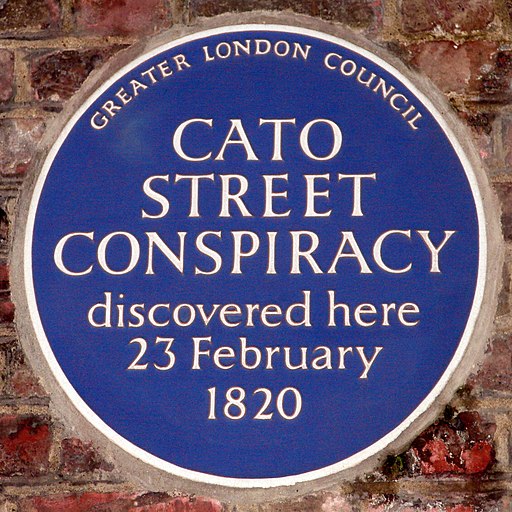
The event promises to transport visitors back to the time of the plot – with free rides on an authentic horse-drawn tram. There’ll be Georgian-era children’s games, performers in period dress and traditional food and drinks from a street vendors. A recording will tell the story of the Cato Street Conspiracy outside the house where the plotters met.
While many people have heard of the Cato Street Conspiracy, details of the plot are not widely known. As George IV came to the throne, England saw widespread unrest due to food shortages, poor living conditions and the treatment of soldiers returning from the Napoleonic Wars.
Political radical, Arthur Thistlewood, led a group of extremists who wanted to change society by violent means. The conspirators met in a stable block on Cato Street (there’s a blue plaque marking the spot) where they were discovered. Four were hanged for high treason, others were transported.
Organised by local resident, Caroline Friedman with support from Marble Arch Business Improvement District (BID), the day aims to shed light on this period of history.
Fancy dress is encouraged – with Jane Austen’s Emma about to hit the big screen, it’s a good excuse to embrace your inner-Georgian. There are prizes for the best outfit.
The free event will take place between noon and 3pm. It will be followed by a one-man play about the Cato Street Conspiracy, performed in the Duke of York pub. Tickets are £7.50 and available from Eventbrite.
Find out more about the event on the Marble Arch BID website where you can also read the story of the Cato Street Conspiracy.
24th February 2020
Thousands of Londoners, including homelessness campaigners, have responded to a call by Mayoral candidate, Rory Stewart to let him sleep on their sofa and learn about their concerns.

The former Conservative leadership candidate is standing as an independent in the election for London Mayor on 7 May 2020.
Rory Stewart launched his #ComeKipWithMe campaign on 11 February. He said: “Fixing London’s issues – whether on crime, housing, or our air quality – will not come from issuing press releases or edicts from a distant office building.
“It comes from getting out into communities across the capital, staying with people – listening to their concerns, as well as their ideas for the best solutions. I promise to bring a sleeping bag and a box of chocolates,”
While the move brought accusations on social media – that it was ‘poverty tourism’ and a bit ‘creepy’ – almost 2,100 people took up Mr Stewart’s offer within three days of the launch. For many it is a chance to tell the candidate about housing concerns such as overcrowding and affordability.
Mr Stewart has already kipped in the Canning Town flat of Lorraine Tabone, who runs the charity Lola’s Homeless. Together they toured east London, discussing issues including homelessness and knife crime. According to Ms Tabone, he was the ‘perfect guest’.
Rory Stewart is standing against existing Mayor, Sadiq Khan, who is not planning on doing anything similar. Mr Khan said: “I’m very clear on my record over the last four years and I’m quite clear about the choices Londoners have. If you vote for me, I promise I will not want to come and sleep at your house.”
In November, a YouGov poll put Mr Khan in the lead with 45% of the vote, ahead of Conservative candidate, Shaun Bailey with 23% and Rory Stewart on 13%.
Read more about this story in The Guardian and Time Out.
14th April 2020
There is plenty of advice doing the rounds about keeping your home virus-free during the lockdown, but how do you tell the sensible precautions from the downright paranoid?

Should you, for example, be binning your post, hosing down your groceries or sticking on a hot wash if you ever venture outside? The Evening Standard Homes & Property has pulled together a useful guide to good home hygiene in difficult times, with advice from Dr Deborah Turbitt from Public Health England (PHE). Here are some highlights.
Many people worry about covid-19 living on surfaces. Transmissions is, however, most likely to happen from close contact with a symptomatic person. According to PHE: “It is also possible to become infected by touching surfaces or objects that have been contaminated with respiratory secretions from an infected person and then touching your own mouth, nose or eyes.” However, regular cleaning of frequently-touched surfaces can reduce the risk.
As long as you are practising the recommended social distancing, PHE does not recommend cleaning your home more often than normal, although you should pay special attention to kitchen and bathroom surfaces, particularly if someone in your household shows symptoms.
“Normal cleaning methods do kill this virus. A regular disinfectant is fine to use, although if you are cleaning after a symptomatic person has come into contact with surfaces, use disposable cloths and mop heads and throw them away after use.”
PHE recommends disinfecting phones and devices, which are touched regularly and held close to your face. The advice is to moisten a lint-free cloth with soapy water and give it a thorough wipe – the BBC has a helpful video tutorial on its website.
The chance of catching the virus from packaging and parcels is thought to be minimal. The advice from PHE is to: “Dispose of waste in your usual rubbish bin and wash your hands thoroughly for 20 seconds using soap and water.”
According to PHE, “Covid-19 can survive on surfaces such as clothes but can be removed by normal washing, so wash items in accordance with the manufacturer’s instructions. Use a warm water setting and dry items completely.”
Read more advice from PHE in Homes & Property.
27th April 2020
The Royal Institution of Chartered Surveyors (RICS) has called for government intervention to prevent falling house prices over the coming year. The professional body for surveyors wants to see a stamp duty holiday once lockdown is over. The call follows its March report, which revealed a reduction in sales, enquiries and price expectations since the covid-19 crisis began.

Hew Edgar, head of government relations at RICS said: “These are exceptional circumstances and the government will need to consider all avenues that could feasibly rebuild confidence, bridging the gap between uncertainty and recovery.
“As we start to emerge from this crisis, it is likely that the finances of potential homebuyers will be under strain, and the burden of stamp duty could put buyers off. For those who can afford to move they may lack confidence in the market, adding to the slow down. A stamp duty holiday could be one of the ways to reactivate the housing market quickly as a short-term measure.”
The RICS UK Residential Market Survey is conducted monthly among member surveyors. Results for the previous two months of 2020 revealed optimism in the market after stagnation during Brexit uncertainty.
However, the March survey found that 74% of respondents expected London house prices to drop within three months. March also saw a drop in newly-agreed sales across the UK with 69% of respondents reporting a fall – down from 19% reporting a rise in February. New homes coming onto the market also saw a fall as did new lettings instructions and tenant demand.
Others across the industry, including property portal Rightmove, have echoed the call for incentives to reactivate the market. Rightmove’s Miles Shipside said: “Owners need to be encouraged to move by reducing the costs of moving, and prospective buyers encouraged to buy by reducing the costs of funding their purchase.”
Read more about this story on the RICS website and the Evening Standard Homes & Property website.
10th August 2020
The government will build 45,000 new homes with investment from Boris Johnson’s promised “New Deal”. The so-called “shovel ready” projects have been announced ahead of radical proposals for reforming the planning system.

The Treasury is allocating £900 million to the 300 schemes, which also include commercial space and infrastructure projects. The investment is expected to create up to 85,000 jobs and reduce CO2 emissions in England by around 65 million kgs.
Major changes to planning laws will speed up the building process for the new homes by granting automatic planning permission for some projects.
Under the proposals, local councils will be asked to designate areas of land for “growth”, “renewal” or “protection”. Projects on land named as “growth” could receive automatic planning permission, while “renewal” areas would receive “permission in principle,” subject to checks. There would be no automatic right to build on areas with “protection” status, which would include the greenbelt.
Developers will also be required to contribute to the infrastructure needed to sustain communities and make sure their designs are in keeping with the character of the area.
More details of the £2 billion Green Homes Grant scheme have also been announced, including strict accreditation rules for tradespeople taking part.
The scheme will see the government fund up to two-thirds of the cost of home improvements, such as wall, floor and roof insulation and low-carbon heating systems. The measures could help homeowners save up to £600 a year on their energy bills. Tradespeople must register with the TrustMark scheme to take part.
According to the housing secretary, Robert Jenrick, the plans are “laying the foundations for a green economic recovery” following the coronavirus pandemic.
Read more about this story in The Guardian and on the government website.
1st September 2020
The government has extended the ban on evictions, due to end on 23 August, for an additional four weeks. The move means no legal evictions will have taken place in England since the ban was introduced in March.

Ministers will also give tenants greater protection from eviction over the winter by requiring landlords to give six months’ notice to vacate a property. This will apply in all cases except those involving anti-social behaviour and domestic abuse and will be in place until at least the end of March 2021. The measures will be reviewed according to the latest public health advice.
Housing Secretary, Robert Jenrick said: “It is right that the most egregious cases, for example those involving anti-social behaviour or domestic abuse perpetrators, begin to be heard in court again; and so when courts reopen, landlords will once again be able to progress these priority cases.”
The extension of the ban follows claims by housing charities that ending it could put 230,000 tenants at risk of homelessness. However, the government says the vast majority of landlords have shown understanding in unprecedented circumstances, taking action to support tenants.
Research for the National Residential Landlords Association (NRLA) found that 87% of tenants have continued to pay full rent since the start of the pandemic, with a further 8% agreeing reduced fees with their landlords. The association called for more action from the government to help landlords.
Ben Beadle, chief executive, said: “When the courts do start to hear cases again, it is essential that they deal swiftly with the most serious cases, including those where tenants are committing anti-social behaviour or where there are long standing rent arrears that have nothing to do with the pandemic.
“To offer security to tenants and landlords badly hit during the lockdown we are calling on the government to introduce a tenant loan scheme to help pay off arrears built up due to coronavirus.”
Read more about this story on the government website.
14th September 2020
The Competition and Markets Authority (CMA) has announced that it will take enforcement action against leading housing developers over the mis-selling of leasehold homes.

The CMA has launched enforcement against Barratt Developments, Countryside Properties, Persimmon Homes and Taylor Wimpey, following an investigation, which uncovered “troubling evidence of potentially unfair terms concerning ground rents in leasehold contracts”.
Issues of concern include developers failing to explain whether ground rents will increase over time and by how much.
People may also have been misled about the cost of converting leasehold homes to freehold ones. Some buyers were initially told they could convert to freehold for a small sum, later finding that the cost had risen to thousands of pounds.
The action will look at unfair contract terms regarding ground rents – in some cases escalating rents were built into contracts meaning they could double in 10 years.
The CMA is also investigating firms who bought freeholds from developers and have continued to impose unfair leasehold terms.
Andrea Coscelli, CMA Chief Executive, said: “It is unacceptable for housing developers to mislead or take advantage of homebuyers. That’s why we’ve launched today’s enforcement action.
“Everyone involved in selling leasehold homes should take note: if our investigation demonstrates that there has been mis-selling or unfair contract terms, these will not be tolerated.”
The CMA says it is working with the government on plans to reform the leasehold market, with a ban on the sale of new leasehold houses and zero ground rents for new leases.
Anna Bailey of the campaigning Leasehold Group, said: “We have been fighting for the rights of leaseholders for 18 years and finally we are starting to see positive action following the largely ineffective pledge made by builders.”
Read more about this story on the government and Property Wire websites.
28th September 2020
Coronavirus may have seen arts events around the country cancelled, but not the BFI London Film Festival. For its 64th outing, the festival has been reimagined with a vibrant programme of 58 films from 40 countries and a mix of physical and virtual premieres.

This autumn’s festival will run from 7 to 18 October, showcasing some highly-anticipated new releases at the BFI Southbank, cinemas across the UK and online through the BFI player.
Here are a few highlights:
Tricia Tuttle, BFI London Film Festival Director, welcomed the chance to go ahead with the event in its new format: “We all want to be back in cinemas, seeing films on the big screen, together, immersed. But we also want to keep seeing new cinematic storytelling from all parts of the world, hearing different voices and perspectives; this version of London Film Festival delivers on both of those aims.”
Read more about the festival programme and book tickets on the BFI website.
12th October 2020
While there’s been plenty of talk about the Chancellor, Rishi Sunak’s stamp duty holiday this summer, new research shows that millions of homebuyers are confused by the tax, with most never considering that they may have overpaid.

The research, from tax company Cornerstone, found that 61% of homebuyers have never considered whether there was a mistake in the stamp duty they paid, while 13% felt they were forced to overpay in error by their solicitor.
Cornerstone estimates that 120,000 people in the UK are owed refunds as a result of issues with stamp duty advice.
According to the survey, 14% of homeowners said they needed to take out a loan to cover the cost of an unexpected stamp duty payment – equivalent to almost two million buyers.
More than half of those questioned (52%) also wanted to see an independent office to audit stamp duty transactions and ensure people’s bills were correct.
David Hannah of Cornerstone Tax said: “These statistics are shocking, if not wholly surprising, when you consider how many amendments have been made to stamp duty in the past few decades.
“While the percentage payment bands at higher property values is fairly straightforward, the number of exemptions and surcharges on different kinds of homes becomes incredibly confusing for even the solicitors and conveyancers advising on these transactions.”
Homebuyers may be entitled to a rebate on stamp duty, if they pay the additional 3% second homes surcharge, then go on to sell one of their properties within three years.
The stamp duty holiday was announced in July and means there is no tax to pay on property transactions under £500,000 until 1 April 2021.
Read more about this story on the Financial Reporter website.
For more about how stamp duty works, visit our blog.
26th October 2020
Prime Minister, Boris Johnson has pledged to ‘turn generation rent into generation buy’ with long-term, fixed-rate 95% mortgages for first-time buyers.

Speaking at the Conservative Party conference, Mr Johnson said there are two million would-be first-time buyers who could afford their monthly mortgage repayments, but struggle to get on the housing ladder because of the large deposit required. The Prime Minster believes unlocking more low-deposit loans will create “the biggest expansion of home ownership since the 1980s”.
The announcement comes as 90% and 95% mortgages have almost disappeared from the market in the wake of the coronavirus crisis. Nine out of 10 low-deposit deals have been removed from sale, with the remainder hard to get and restrictions placed on the type of homes eligible.
The government has not made it clear where the low-cost loans will come from or whether a change in legislation will be required.
Bank of England regulations, introduced after the financial crash of 2008, currently limit borrowing to four-and-a-half times the customer’s annual income, while restricting the number of loans companies can offer at this level.
The government may decide to remove this ‘stress test’, but it would mean passing on financial risk to lenders at a time of economic uncertainty. Alternatively, the Government may offer to guarantee higher loans, taking on the added risk – a scheme similar to the Help to Buy mortgages introduced after the financial crisis.
However, even with government backing, buying a home with a low deposit could put these purchasers at risk of negative equity; if house prices fall after the current stamp duty holiday boom.
According to a report by Legal & General, more than half (56%) of under-35s need help from their parents when buying a home, to the tune of £19,000, on average. Seven out of 10 of these buyers said they couldn’t have got onto the property ladder without this assistance.
Read more about this story in Which? And Homes & Property.
9th November 2020
The government has announced an extension of the mortgage payment holiday scheme, which was due to end last month. The extension will run until 2 December, to coincide with the new national lockdown in England, which came into force on 5 November.

Extending mortgage payment holidays means that borrowers, who haven’t already taken advantage of the scheme can still do so, pausing their payments for up to six months. People who have already made use of a payment holiday can extend theirs up to the six-month limit.
Mortgage payment holidays were introduced during the spring lockdown. Take-up of the scheme peaked in June, when 1.8 million payment holidays were in place.
While a benefit for people unable to meet their payments in the short term, the scheme only defers mortgage payments with the interest owing added to the outstanding debt. This means the missed payments will need to be made up at some point in the future.
Borrowers worried about meeting their payments are advised to get in touch with their lender, to find the right solution for them. Other options include moving to an interest only mortgage or extending the mortgage term.
Mark Harris, chief executive of mortgage broker SPF Private Clients, welcomed the government’s decision: “It is good to see such decisive action taken so quickly. Many borrowers will be worrying about paying their mortgage and extending payment deferrals for a further six months will provide them with some comfort.
“However, the advice remains the same – only ask for a payment deferral if you need one. Interest will still rack up and you will have more to pay off in the long run so the option should only be utilised by those who really need it.”
Read more about this story on the Property Wire website.
23rd November 2020
Lockdown may be keeping Londoners home, but Oxford Street’s Christmas lights shine on in 2020, with a heart-warming message which celebrates unsung heroes.

After a low-key switch on just before lockdown began, the capital’s major shopping street is decked with 27 ‘curtains’ of 222,000 LED lights spelling out To London with Love; a poem specially-created in partnership with Selfridges.
For the rest of the festive season, the installation will feature the names of local heroes, who have taken part in the NHS Volunteer Responder scheme. The scheme is delivered by the charity Royal Voluntary Service (RVS). Volunteer responders help vulnerable people with shopping, prescription collection, travel to medical appointments and by calling them for a chat.
The first hero to see his name in lights was train driver, Anis Ali from Morden. Having signed up as a responder early in the pandemic, Anis has completed more than 700 tasks since March.
After almost five years of intense wrangling, Britain will finally exit the European Union on 31 December, when the current transition period ends – with or without a deal. While it may feel like Brexit has always been with us, it’s often difficult to imagine what the UK’s exit from the EU and customs union will actually mean for citizens. The Independent has been looking at the implications for homeowners – on mortgages and house prices.

Achieving a deal with the European Union could help avoid any short-term disruption to the housing market. After closing down completely during the first coronavirus lockdown, the market sprang back into life in late summer and autumn with the announcement of the chancellor’s stamp duty holiday. House prices have remained stable, or risen in some areas, where demand has outstripped supply. A deal with the European Union would be unlikely to have an impact on this.
Mortgages too may not be affected as they are largely dependent on decisions about the base rate by the Bank of England. A deal would be less turbulent for the economy, which could encourage the bank to increase the current, historically-low, rates. However, the impact of the pandemic on people’s personal finances, may mean the Bank decides to leave well alone.
This scenario certainly makes commentators more nervous, with worries that a rise in unemployment – due to the ongoing pandemic and a no-deal Brexit – could have a negative effect on prices.
Here at Kubie Gold we are optimistic about the prime central London property market in 2021 and are looking forward to working with both our new and existing clients.
We wish you health and prosperity in 2021.


When viewing a house to rent it is important to ask the right questions as you could be living in it for some time – Our blog lists 15 to...

From locating your decorations to coping with a snowy move, read our essential tips for avoiding double the stress, if you’re moving hous...

Asking prices rose slightly in October, in spite of uncertainty in the financial markets, the latest figures from property website Rightm...


